The Wonder
Forty-two thousand corners. The engineering underneath the set piece revolution, pipe by pipe.
Set Pieces · Corners · Takers · 2015/16 to 2025/26
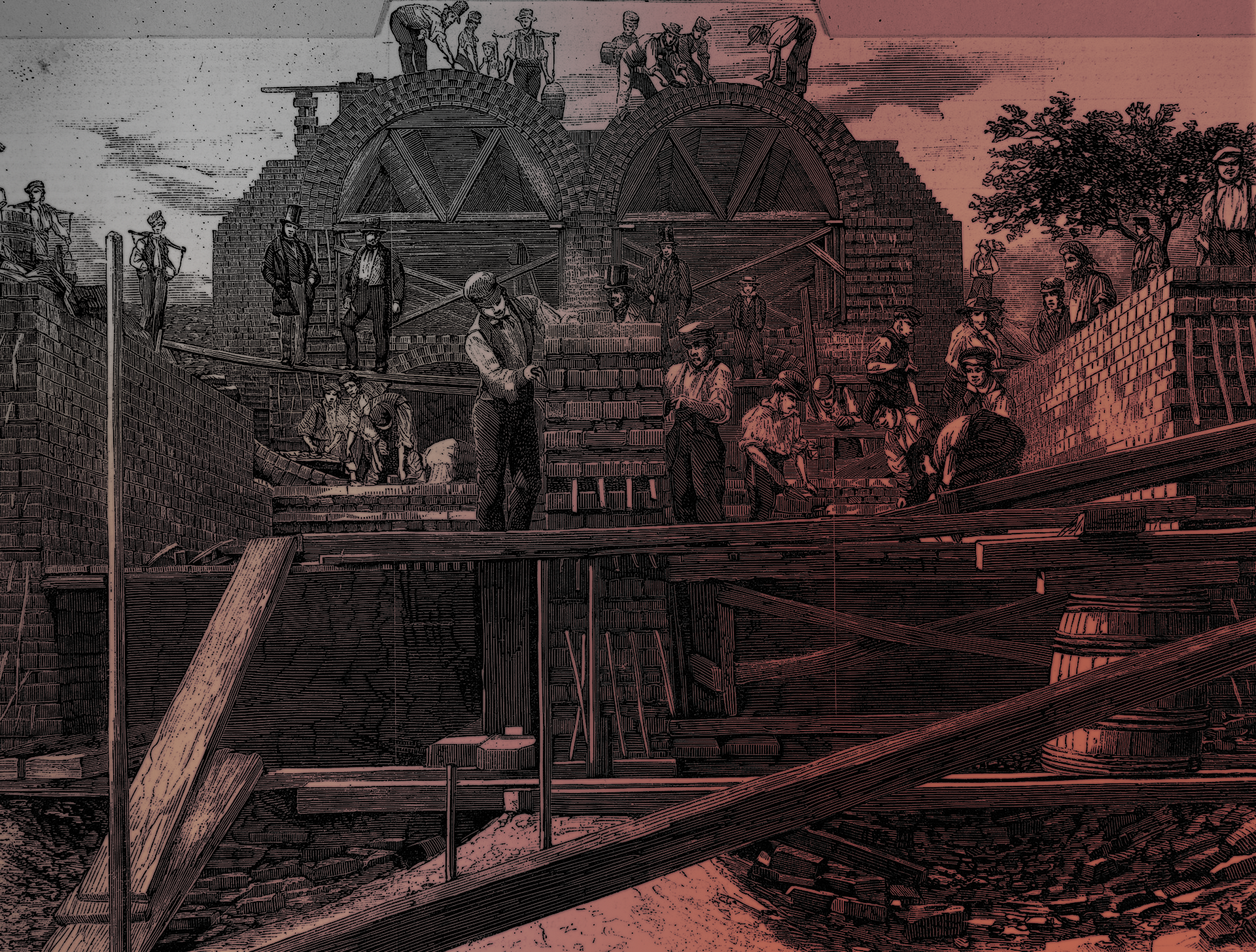
A Thames Water engineer lifts a manhole cover on the Victoria Embankment. She clips her harness to the rung ladder and descends. The shaft is narrow, the iron cold from overnight rain. At the bottom, eight metres below the street, she finds what she always finds: egg-shaped Portland cement brick, laid in 1865, the mortar still tight. Bazalgette designed these intercepting sewers for a city of two and a half million. London is now nine million. The gradient is exact. The junctions are clean. The brickwork holds because it was engineered to solve a structural problem, not a temporary one.
Corners have always existed. Long throws have always existed. What changed is not the delivery but the infrastructure around it: the zone targeting, the second-phase organisation, the coaching systems that turn an interruption into architecture. The set piece revolution is old work done properly for the first time. Bazalgette's contribution was engineering, not invention.
The second ball
An inswinger from the right, hit with pace, curving into the six-yard box where seven players are packed into a rectangle no wider than a Transit van. Two players contest the aerial duel at the near post. Neither wins cleanly. The ball deflects off a shoulder, drops to the edge of the six-yard box — and a midfielder arriving late, unmarked because every eye followed the header, hits it first time with his right foot. 5.3 seconds from delivery. Goal.
Across 42,000 corner deliveries and eleven Premier League seasons, the majority of linked corner goals come from second-phase play. Foot shots on loose balls, after the aerial contest has been lost or half-won.
The mechanism
Most corner goals come from feet, not headers. Peak conversion is after the aerial contest drops.
The pattern sharpens when you break it by time from delivery. In the first two seconds after a corner is taken, the vast majority of shots are headers. By five to seven seconds, the ratio has flipped: most shots are from feet. The most dangerous moment in a corner sequence is not the first contact but the third or fourth, when the ball has dropped out of the aerial contest into the path of a runner whose feet are set.
Height helps win the aerial duel. The goal comes after the aerial duel, from feet. The folk belief that height drives corner goals — the miasma — is wrong at every level of magnification.
One zone makes the mechanism visible. Deliveries to the edge of the penalty area produce a goals-per-delivery rate driven almost entirely by second-ball sequences. These deliveries look like failures. They land twelve yards from goal, too far for a direct header. But the ball dropping from a contested aerial at the near post has to land somewhere. Often it lands at the edge of the box, where an unmarked player is waiting. Different pipe, same water.
The main line
The six-yard box is productive not because headers score there, but because it is where aerial contests happen, and aerial contests produce foot shots. In 2015/16, 41% of in-box corner deliveries in the Premier League targeted the six-yard box. In 2025/26: 63%. The shift has come entirely at the expense of the penalty-spot delivery. Short corners have held steady at four to six per cent.
The main line
Where 40,000 corner deliveries landed. The six-yard box absorbed a decade of deliveries without degrading.
In-box share shifted from 41% six-yard targeting in 2015/16 to 63% in 2025/26.
The six-yard box was always the most productive delivery zone. But in 2015/16, teams targeted it only 41% of the time, not for lack of evidence but for lack of infrastructure. The runners were undrilled, the second phase unplanned, the blocking patterns unrehearsed. The zone was already there. What arrived was the system.
Three structural features of the Laws of the Game explain why the zone has not degraded despite the entire league flooding it with deliveries.
The offside exemption inverts the geometry. In open play, the defensive line compresses the pitch and prevents attackers from occupying the six-yard area. At corners, attackers pre-load the zone with bodies before the ball is struck. No offside. No constraint.
Contact is tolerated differently at set pieces. Blocking, screening, holding positions in the six-yard box during a corner is routine and rarely penalised. The meat wall exists because the rules permit it. The wall is the rational defensive response to a quality delivery into a packed zone. The zone still works despite it. Goals per delivery has not declined.
And no defensive scheme solves the underlying dilemma. A defence that packs the six-yard box concedes space at the penalty spot and the edge of the area. A defence that spreads the markers leaves gaps in the most productive zone. A quality delivery into the goal mouth at pace, with runners who know where the ball is going and defenders who do not, remains structurally advantaged regardless of the formation.
These are permanent features of the game, not tactical choices that coaching can overcome. Which is why Arsenal under Jover don't look like a team exploiting a loophole. They look like a team running the system at full capacity.
Arsenal under Jover. 76.4% six-yard targeting in his first full season. 85.9% in his fourth. The highest rate in a decade of Premier League data. The floor lifts each year. Jover arrived four seasons ago. He has been iterating ever since.
The takers
Footedness drives delivery. The profile travels with the player. Four managers found a way around it.
Christian Eriksen targets the six-yard box from the left, his inswing side, and the penalty area from the right, his outswing side. The split is stable across Tottenham, Brentford, and Manchester United: three clubs, three managers, the same asymmetry. Dwight McNeil carries 75% six-yard targeting from Burnley to Everton, unchanged. Willian holds the same pattern from Chelsea to Arsenal to Fulham across nine years.
Coaching overrides are different. Four examples in the data show a manager shifting a taker's six-yard rate by 33 to 50 percentage points on one side while the other side stays flat. The override always targets the player's better inswing side. The outswing side stays unchanged. The coaching is specific and directional.
The override
Coaching shifts the inswing side. The other side stays flat. Trippier and Pereira shown; Westwood and Dewsbury-Hall follow the same pattern.
Dyche is the thread that ties it together. He reshaped Westwood across four Burnley seasons — 33% six-yard targeting at Aston Villa, 83% at Burnley. McNeil arrived already targeting 75%. Dyche did not override him because there was nothing to override. The system imprints on the player, not the club. The player carries the instruction to his next team.
The pattern is not Dyche-specific: Dewsbury-Hall arrived at Everton targeting 49%, finished 2025/26 at 82% under Moyes. Different manager, same instruction, same directional result.
A different pipe
The corner system is coachable, replicable, spreading across the league. The long throw is different. A 35-yard throw that reaches the six-yard box cannot be coached into existence. It is genuinely rare at the elite level. You either have a Kayode or you do not.
But having the thrower is not enough. Brentford's long throw was available from the moment Kayode arrived. The shot volume came later, with coaching.
Andrews is Jover for the long throw. The throw is free: the club gets it as part of having Kayode. Andrews is the pipe that runs water through it: the runner placement, the second-phase organisation, the routine built around a delivery the opposition cannot replicate. The capability comes with the player. The system is coaching.
The risk framing is wrong. "You can't play someone just because they can take long throws" misunderstands what the throw produces. The throw almost never produces the goal itself. It produces the conditions for the goal: a contested aerial, a dropped ball, a foot shot in the chaos. The mechanism mirrors the corner second ball. The player who throws does not need to be the one who scores.
The political question
The biggest threat to the engineering is political, not tactical.
Arsenal sit at the centre of the debate. The "meat wall" is pejorative. Of course it is. Tribes will be tribal. Set pieces are unfair, arguably even cheating. Nevermind that the team also creates and scores from open play at a level that puts them well above most of the league.
The objection is loudest against the teams doing it best and doing the best, not the teams doing it at all. There's no concern when 16/17 West Brom scored 16 set piece goals under Tony Pulis. The argument tracks competitive threat more than aesthetic harm. And so the rules around set pieces may change, in aid of beautifying our game once again. But not because data or history has persuaded the lawmakers. Rule changes, inevitably, are driven by perception. And the perceiving is fickle.
Like clockwork, IFAB recently announced their annual slate of rule changes. They have imposed a visual 5-second countdown on throw-ins and goal kicks. Corenrs are unscatehed for now. That said, they may more strictly enforce blocking and screening violations in the box. In the future, perhaps the offside exemption on corners will go.
Football has legislated away effective strategies before, and will do it again. The backpass and 8-second rule killed time-wasting by goalkeepers. Offside changes reshaped defensive lines and compressed the action. If enough people shout that set piece engineering ruins football, the ground shifts and the pipes will have adjusted, or even ripped up and laid anew. But the pipes will always be there.
Modern sport is about taking every last advantage you can to win. These fine margins can be distracting, even off-putting for most, but the sport has a way of adapting and thriving despite it all. For now, set pieces will draw ire but their time in the sun will pass as the game and the rules evolve. The old adage is that champions win even when they play badly. The modern adaptation is they win with goals of all kinds. Aspiring champions do not fear the stink. They do not turn their noses up at advantage. You may find it nauseating, and you may be right, but in the fullness of time, there are no poor champions.
Methods
42,000 corner deliveries and 17,000 corner shots from 2015/16 to 2025/26. 540 taker profiles across 11 seasons. 26,000 long throw deliveries. Delivery-to-shot linking by time proximity (2-12 second window). 2025/26 event data includes a small number of domestic cup matches (1-2 per team) alongside Premier League fixtures. Full methodology: Methods and Data Sources.
Follow your club's set piece record in the myTeam app
Live scores, fixtures, and stats for every Premier League club.